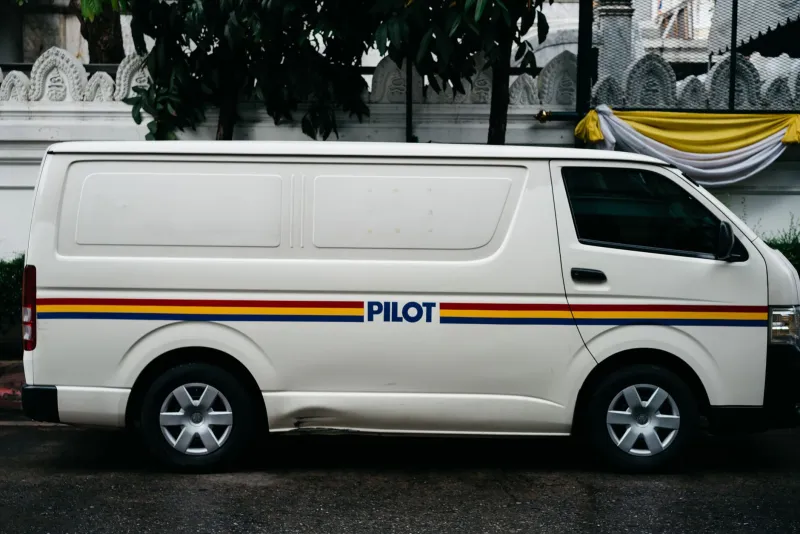
The Van That Earns Its Keep: Fleet Livery as a Working Media Channel
Photo: Francisclarke, CC BY-SA 4.0, via Wikimedia Commons
Most UK SMEs already own a media channel. It is parked outside the unit, covered in road film, and currently advertising nothing more than the fact that somebody has a van.
Fleet livery often gets filed under ‘signage’ and forgotten until renewal time. That is a costly habit. A van, lorry, or service fleet moves through the places your buyers actually go — high streets, business parks, retail car parks, trade counters, residential streets — without paying for media space. It is not a billboard. It is a repeated, mobile touchpoint that happens to come with a diesel bill.
The opportunity in 2026 is not to cover every panel in slogans. It is to treat the fleet as a working media channel: designed for the distances people see it from, scheduled around the routes it genuinely drives, and judged on whether it earns its keep.
A moving ad is not a poster on wheels
The first mistake is designing livery as if it will be read standing still. Most people will see your van for two or three seconds at a junction, in a mirror, or across a car park. Some will see it for twenty minutes while it is parked at a job. Those are different reading conditions, and both matter.
For distance, you need one idea and very few words. The company name, a clear category cue, and one reason to get in touch will do more than a full list of services in 38pt type. Contrast matters more than cleverness. Dark text on a dirty white panel disappears. A busy photographic wrap can turn into visual soup at forty metres.
For dwell time — when the vehicle is parked and people have longer to look — you can afford the useful details: website, phone number, service area, accreditation logos, perhaps a short line about what makes you different. But those details should not crowd out the thing people need to recognise first.
Ask yourself a simple question: if someone saw the van for three seconds and then saw it again a week later, what would stick? If the answer is ‘not much’, the design is doing decoration rather than advertising.
Routes are a media plan
A fleet does not reach ‘everyone’. It reaches the roads it drives, the customers it visits, and the places it parks. That is an advantage, not a limitation. It means you can think about coverage in a way that is more honest than most digital targeting decks.
If your work is clustered in certain postcodes, your vans are already building frequency there. If you want to push into a neighbouring town, route the fleet through it rather than simply hoping the wind carries your brand. If you have engineers or drivers who regularly stop at the same trade counters and retail parks, those stops are dwell-time placements. They are free, but they are not accidental.
This is where fleet livery starts to behave like a campaign rather than a one-off print job. You can align the message with the season — boiler servicing before winter, commercial removals before quarter-end, garden work in spring — without reprinting the whole vehicle. Magnetic panels, rear-door decals, and removable bumper strips can give an SME a bit of campaign flexibility without a full wrap.
Local trust is built in the mirrors
In the UK, a branded van still does something subtle that a digital ad cannot. It proves presence. A vehicle with a real phone number, a local area name, and a tidy finish says there is a business nearby that turns up, does the work, and answers the phone. That matters for trades, home services, property, food distribution, and plenty of B2B categories where buyers are quietly weighing up risk.
But trust cues only work if they are consistent. Five vans with five different layouts look like five different companies. A phone number that has changed since the last print run looks careless. A website that still says ‘coming soon’ undoes the good work of the cab door. The fleet is a public-facing asset, so it deserves the same approval process as a press ad or a landing page.
The usual ways a fleet turns into rolling clutter
The most common mistakes are not exotic. They are the familiar ones:
- Too many words, too little contrast, and a logo that only works on a laptop screen.
- Service lists that read like an internal menu rather than a customer promise.
- Inconsistent liveries across vehicles, so the fleet never accumulates recognition.
- Contact details that are technically present but unreadable in motion.
- No thought about the back doors, which are often the longest-viewed panel in traffic.
- Vehicles that are rarely cleaned, which quietly tells buyers something about the service.
- No link between the livery and the rest of the campaign, so the van exists in its own little world.
- No measurement at all, beyond a vague sense that ‘the vans are out there’.
Measurement does not have to be complicated. You can track branded enquiries, use a dedicated landing page or phone number, ask new customers how they found you, and compare activity in areas where the fleet is concentrated. None of that is perfect, but it is better than treating livery as a sunk cost.
A simple fleet checklist for 2026
Before you sign off the next set of panels, run this quick test:
- Can a stranger identify what you do from fifteen metres away?
- Is there one clear next step — phone, website, or QR code — rather than four competing calls to action?
- Does the design still work when the van is dirty, half-lit, or seen in a wing mirror?
- Have you designed the rear and sides for the angles people actually see in traffic?
- Do the routes match the areas you want to grow?
- Is the contact information current and easy to read at a glance?
- Do all vehicles look like they belong to the same business?
- Is there a way to tell whether the fleet is generating enquiries rather than just looking busy?
A fleet is never going to replace a well-planned campaign. But for plenty of UK SMEs, it is the most underpriced ad space they already own. Treat the vans as media, design for the distance and the dwell, and give them a job beyond getting from A to B. The white van rule is simple: if it is on the road, it should be earning its keep.